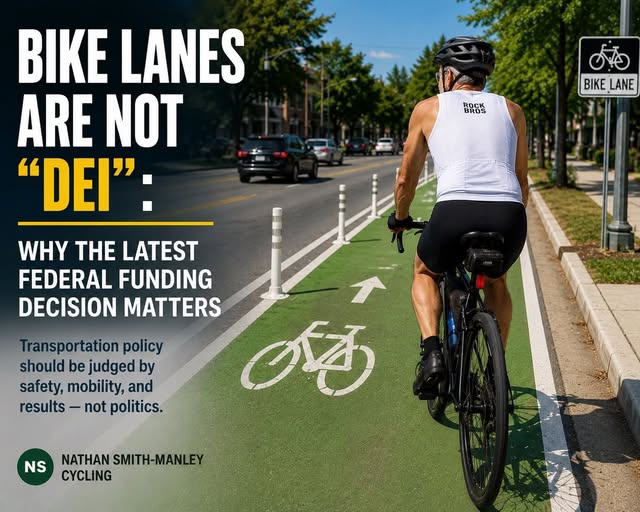
For decades, transportation policy has largely been driven by engineering, safety data, and economic priorities. Unfortunately, recent developments in Washington suggest that transportation infrastructure is becoming another front in America's ongoing culture wars. This week, U.S. Transportation Secretary Sean Duffy announced that the Department of Transportation is awarding $1.73 billion in infrastructure grants focused on roads, bridges, ports, and aviation projects, while no funding has been designated specifically for bicycle infrastructure. In defending the decision, Duffy referred to bicycle projects funded under the previous administration as "DEI bike lanes," arguing that the administration is moving away from projects tied to diversity and climate initiatives.
The federal government has every right to establish its own transportation priorities. Elections have consequences, and every administration emphasizes different infrastructure needs. However, reducing bicycle infrastructure to a political slogan does a disservice to an important discussion about transportation safety and mobility. Whether someone supports or opposes the administration's policy choices, Americans deserve an honest conversation based on facts rather than labels.
Calling bike lanes "DEI" does not change what they are designed to accomplish. Bike lanes exist because transportation engineers have long recognized that separating bicycles from faster, heavier motor vehicles can reduce conflicts between road users. A bicycle and a passenger vehicle occupy the same roadway, but they do so with dramatically different speeds, weights, and levels of protection. When those differences are managed through thoughtful street design, everyone benefits. Drivers have more predictable traffic patterns, cyclists have a safer place to ride, pedestrians experience fewer conflicts on sidewalks, and emergency responders face fewer severe crashes.
This is not a new concept, nor is it a partisan one. Long before the phrase "DEI" entered the national political vocabulary, engineers, planners, and safety researchers were studying how different street designs affected crash rates. The laws of physics have not changed because political administrations have. A collision between a two-ton automobile and a person riding a bicycle remains just as dangerous today as it was twenty years ago. Transportation infrastructure should respond to those realities rather than to political messaging.
One misconception that often surfaces during these debates is the idea that bicycle infrastructure primarily serves recreational cyclists. While recreational cycling certainly benefits from safer roads, bicycles are also an important form of everyday transportation. Across the country, people ride to work, to school, to medical appointments, to grocery stores, and to public transit stations. Some ride because they enjoy it. Others ride because they cannot afford another vehicle or because cycling is the most practical option for short trips. Transportation systems should accommodate the many ways people travel rather than assuming every trip must be made by automobile.
Another claim frequently made by opponents of bicycle infrastructure is that roads belong primarily to motorists because they pay fuel taxes. In reality, transportation funding is far more complex. Roads are financed through a combination of federal and state taxes, property taxes, sales taxes, vehicle registration fees, general fund appropriations, and fuel taxes. Cyclists contribute to these revenue sources just as everyone else does. Many cyclists also own and drive cars, meaning they pay fuel taxes and registration fees in addition to the broader taxes that support public infrastructure. Public roads are exactly that—public. They are built to serve everyone who uses them legally.
The irony is that well-designed bike lanes often make driving easier. Without dedicated bicycle facilities, motorists frequently find themselves slowing behind cyclists, waiting for safe opportunities to pass, or navigating unpredictable interactions on narrow roads. Dedicated bike lanes help organize traffic by giving each mode of transportation its own space. That reduces frustration, improves predictability, and can make traffic flow more smoothly. In other words, investing in bicycle infrastructure is not about choosing cyclists over drivers. It is about creating a transportation system where different users can coexist more safely and efficiently.
Cycling also provides benefits that extend well beyond those who ride. Every person who chooses to travel by bicycle instead of by car represents one fewer vehicle contributing to traffic congestion, competing for parking, wearing down pavement, and consuming fuel. Even residents who never ride a bicycle benefit when others choose alternative forms of transportation because those choices reduce pressure on the transportation network as a whole. This is one reason many communities continue investing in multimodal transportation despite changing political winds at the federal level.
Reasonable people can certainly debate how transportation dollars should be allocated. Some communities may prioritize bridge repairs, while others may need highway expansions or transit improvements. Those are legitimate policy discussions that should be based on local needs, available funding, and measurable outcomes. What is less helpful is framing bicycle infrastructure as though it were simply a political symbol rather than a transportation investment. Labels such as "DEI bike lanes" may generate headlines, but they do little to address the practical questions communities face about safety, congestion, and mobility.
It is also important to recognize that federal transportation policy changes over time. Every administration reevaluates grant programs and funding priorities according to its own objectives. While the current administration has shifted away from dedicated bicycle funding within this round of infrastructure grants, state governments, regional planning organizations, counties, and municipalities continue to have the ability to invest in bicycle infrastructure if they determine it serves their communities. Federal grants represent only one piece of America's transportation funding system.
Ultimately, transportation policy should focus on outcomes rather than ideology. The important questions are not whether bike lanes are "woke" or whether they can be tied to one political philosophy or another. The important questions are whether they improve safety, reduce conflicts between road users, provide additional transportation choices, and make communities more functional. Those questions can be answered with engineering, data, and experience rather than political rhetoric.
America's transportation system has always been strongest when it recognizes that different people travel in different ways. Cars, trucks, buses, trains, pedestrians, wheelchairs, and bicycles all have legitimate roles to play in moving people safely and efficiently. Political priorities will continue to change from one administration to the next, but the fundamental goal of transportation infrastructure should remain constant: building roads and streets that allow every member of the public to travel safely. That objective should never become a casualty of partisan politics.